Categories

Showing posts with label Stashbusters. Show all posts

Dec 12, 2019

Pattern | Healdan Scarf

Longing for a dashing scarf that’s fast, easy and reversible? This design offers that and more. Healdan, an Old English word meaning to care for or protect, is a versatile unisex design suitable for folks of all ages.


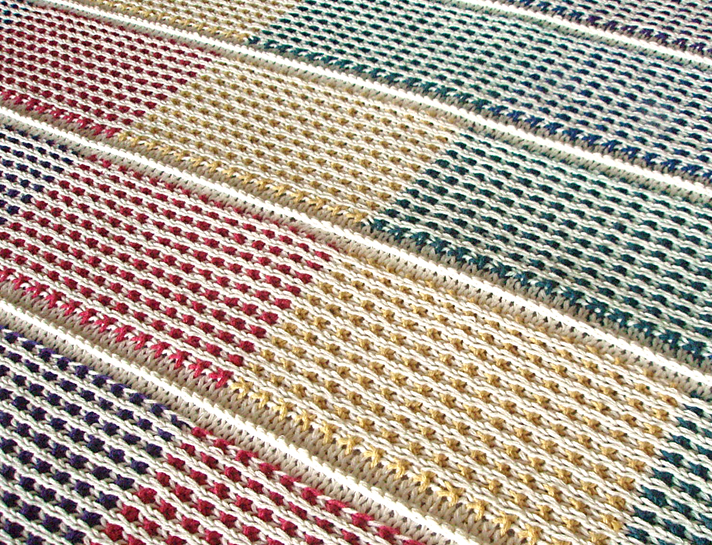
Slipped stitches create an attractive fabric with fluted columns on one side and fluted ribs on the other. The stitch is easy to execute, knits quickly and is appealing in one color or many.

Go classic with a single solid or tonal yarn, work a subtle two-tone weave, or craft a custom gradient, ombre or fade. No matter what option you choose, the colorwork is easy, because only one color is worked on a row.

The pattern is written for sock/fingering weight or lace weight held double, but it readily adapts to any yarn weight or fiber. As an added plus, it includes directions for three lengths (48, 60, 72 ins), three widths (4, 6, 8 ins), and five color strategies ranging from a solid and two-tone weave to different gradient effects. Work it as written or use the handy Quick Reference guide, stitch chart, tips, tricks and easy modifications to tailor your project to suit your tastes.
                     
Healdan Scarf | Fast, Easy & Reversible 
Skill Level 2: Easy
Yarn: Sock/fingering or lace weight held double
Needles: US 8 (5 mm), US 9 (5.5 mm) or whatever size works for you
Sizes: Three lengths (48, 60, 72 ins) and three widths (4, 6, 8 ins)
Yardage (approx.): 240 to 645 yards (fingering); 480 to 1290 yards (lace weight held double)

With Healdan, the:

  • Slipped stitch is extremely easy to execute, equally easy to memorize, and it produces a a lovely fabric that's fully reversible.
  • Flat construction keeps your project compact and portable, so you can work it on the go.
  • Colorwork is easy, because only one color is worked on a row.
  • Five color strategies help you tailor each scarf to your tastes or those of the recipient.
  • Pattern is simple enough for any moderately experienced beginner. It's concise but complete, with written directions, stitch chart, stitch counts, yardage and dimensions for each size.
  • Yarn choice is completely up to you. The pattern is written for sock/fingering weight or lace weight held double, but it readily adapts to other weights and multi-stranding.
  • Design is versatile and unisex, suitable for all ages, and can be worked in different yarns and countless combinations. 


The only limitation is your imagination. Create a timeless look with muted neutrals, or go bold with brights, classic with gem tones, or whimsical with rainbow hues. Add a lush touch with luxury yarn, texture with a rustic tweed, or a trendy feel with speckled yarns. Simplify your color choices by indulging in a gradient or ombre mini-skein collection, or craft your own. 

For dramatic impact with minimal fuss, try a slow-change gradient or rainbow yarn. To tone down pooling, pair a busy variegated with a closely related solid, or add a touch of glam by combining glitter or metallic yarn with a contrasting solid.

If you're feeling brave and want to quickly work up a last-minute holiday gift, substitute a heavier yarn weight or multi-strand lighter weight yarns and use larger needles. Fast, easy and fully reversible, Healdan is suited to any knitter who can cast on, knit, k2tog, ktbl, purl, slip stitches and bind off.

To view the Ravelry description and purchase the Healdan scarf pattern, click here. (And don't forget, you don't have to be a Ravelry member to buy patterns.)

Happy holidays and happy knitting! 


FYI
Want to learn more? See FO| Healdan Rose GradientFO | Healdan Plumberry Mitts & Scarf .
Shopping at your favorite LYS? All patterns are activated for in-store sales.
Experimenting with color combos? These articles offer ideas and inspiration.

Nov 24, 2019

Pattern | Kintra Cowl-Scarf

The name says it all. Kintra, an early American colloquialism for family, friends and folks nearby, is a versatile unisex design that’s also fast, easy and fully reversible  perfect for yourself and every knitworthy person you know.

Slipped stitches create a plush, ribbed fabric that’s stretchy and identical on both sides. Integrated I-cord edges add a polished look and minimize finishing, while optional button closures make Kintra easy to grab, wrap and go.

Written for sport weight yarn with a bit of memory, the pattern readily adapts to any yarn weight and multi-stranding. So, whether you're eyeing a special yarn at your favorite yarn store, seeking the perfect pattern for a treasured mini-skein collection, or using great stash yarns, Kintra offers a host of possibilities.
Go classic with muted neutrals, bold with brights, timeless with rich gem shades, understated with earth tones or whimsical with rainbow hues. Break out your favorite gradient or ombre yarn, or choose a family of closely related shades to craft your own. Add a luxe touch with premium yarns, texture with rustic tweeds, an on-trend feel with speckled or variegated yarns, or a soft sheen with wool-silk blends. 

Use a slow-change gradient or rainbow yarn for high impact with minimal fuss. Tone down a busy variegated by pairing it with a related solid, or add a touch of glam by doing the same with glitter or metallic yarn. 


Skill Level 2: Easy
Yarn: Sport weight
Needles: US 7 (4.5 mm)  and US 8 (5 mm), or whatever size(s) work for you
Sizes: Two lengths (25 ins, 50 ins) and three widths (5 ins, 7 ins, 9 ins)
Yardage (approx.): 200 to 760 yards

With Kintra, the:

  • Slipped stitch is extremely easy to execute, equally easy to memorize, and it produces a plush, stretchy fabric that's fully reversible.
  • Flat construction keeps your project compact and portable, so you can work on it anytime and anywhere.
  • Elements like simple accent stripes allow you to tailor each project to your tastes or those of the recipient.
  • Pattern is simple enough for any moderately experienced beginner. It's concise but complete, with written directions, stitch chart, stitch counts, yardage and dimensions for each size.
  • Yarn choice is completely up to you, but for best results choose something with a bit of memory (wool and wool blends work beautifully). Written for sport weight, the pattern readily adapts to other weights and multi-stranding.
  • Design is versatile and unisex, suitable for all ages, and can be worked in different yarns and countless combinations. 

The pattern includes directions for two lengths (25 ins, 50 ins), three widths (5 ins, 7 ins, 9 ins), and four color strategies ranging from solids and stripes to blended gradients.

The choice is yours. You can work the pattern as written or use the handy Quick Reference guide, stitch chart, tips, tricks and easy modifications to customize every version you make. 

Whether you're knitting for yourself or others, you'll find the Kintra cowl-scarf is fast, easy and suited to any knitter who can cast on, knit, k2tog, ktbl, purl, slip stitches and bind off.

To view the Ravelry description and purchase the Kintra cowl-scarf pattern, click here. (And just a friendly reminder, you don't have to be a Ravelry member to buy patterns.)

FYI
Want to learn more? See FO | Kintra Nearly Neutral Cowl-ScarfFO | Kintra Red Cash Silk Cowl.
Shopping at your favorite LYS? All patterns are activated for in-store sales.
Experimenting with color combos? These articles offer ideas and inspiration.

Oct 6, 2019

The Next Big Thing

Okay, technically, the Ohio Star afghan (my largest current WIP) isn't quite finished. The border is done, but I've decided to add a final edging, which looks nice and does a dandy job of minimizing curl.

That said, with completion of the Wyndfael cowl, my active project list has shrunk from six to four (two scarves, one shawl and the aforementioned afghan), so it's time to start thinking about the next big thing.

And this is where things get a bit dicey. For weeks, I've been tantalized by the prospect of casting on a rainbow shawl using lovely fingering weight yarn (Charlemont, Valley Yarns). The pattern is roughed out, and the yarn is wound and at the ready.
Unfortunately, just as I went to retrieve the yarn from the cupboard, a wayward thought popped into my mind and whispered in a sultry voice, What about that other shawl project? You know, the one that's been on your to-do list much, much longer? The idea was to pair the delightful Helen's Lace (Lorna's Laces) with the variegated Rayon Metallic (Blue Heron), a combo that seemed promising. Here, too, the pattern is roughed out, and the yarn is ready and waiting.


So, what's a knitter to do? 

In theory, I could cast on both and work them simultaneously, but that approach has several glaring flaws. I'm a slow knitter, so it simply means when true cold weather hits I'll have two partially complete shawls, rather one done (or nearly so). It also adds two new projects to the WIP list, which puts me back where I started.

While I'm trying to wrestle this decision to the mat, perhaps I should just pick up the afghan, start working the final edging, weave a few ends, and see what revelations emerge.

Sep 29, 2019

FO | Wyndfael Cowl

The current temps are in the high 80s (F), and they're projected to hit the low-to-mid 90s next week. Nonetheless, I've been busy putting the finishing touches on my Wyndfael cowl. I worked the accent stripes and rounded ends, then buckled down and began weaving ends.

The ends incorporate a small, nearly invisible button hole, which centers the button where the two ends meet. I like to keep my options open, so I attached a large, decorative button to a smaller backer button to create a removable cufflink-style closure, and this is the result.


Wyndfael Turquoise Cowl
Pattern: In development (coming soon!)
Yarn: Merino 5 (Crystal Palace); Cash Vero (Cascade)
Size: Short (~5 x 21 inches) 
Weight: Worsted
Needles: US 8 (5 mm)

Yardage: ~140 yards 

The removable button turned out to be a wise choice, because somewhere along the line I had a wacky idea ... 

What if I used a small pompom as a closure, instead of a button? I decided to give it a try and this is the outcome. Like the cufflink closure above, it's attached to a small backer button, which fits through the existing loops, so it, too, can be swapped out for wearing or washing. As an added plus, the pompom automatically matches, so it circumvents the sometimes frustrating search for a suitable button.


I confess I'm truly delighted with how this turned out. When cool weather arrives, I'll have a warm, cushy cowl to wrap around my neck, a matching pair of mitts to keep my hands warm, and when the mood strikes, I can go for whimsical or classic, whichever suits best.

And it's completely possible there may be a turquoise pompom in my near future ...


RELATED
    Pattern | Wyndfael Mitts

Sep 8, 2019

Surprise Ending

Last week, I was moaning about the hot mess that was my red, white and blue afghan, but since then a lot has been accomplished. The border has been finished and bound off, and for now, the afghan is cooling its heels while I gear up to weave ends (to do this well, I have to be in the right state of mind) and prep for blocking.

To stay productive and continue to chip away at the WIP pile, I picked up my Wyndfael cowl. Designed to match my Wyndfael mitts, this was supposed to be a super-quick knit. Somewhere along the way, I was tempted by another project, so it was set aside. Now, 11 months later, I'm finally ready to buckle down and finish it.

Similar to the mitts, I'm incorporating accent stripes in rich purple, a color I love with this shade of turquoise. I also decided to work rounded ends for visual interest, a bit of a surprise ending if you will.

The first end is completed (sorry, bad photo of the wrong side) and I've begun working the second. With a bit of luck and some knitting time, I'll soon have this piece bound off, and ready to finish and block. (Update: Done!)

Once both the afghan and cowl are done, my WIP list will pared down to three active projects, a feat I plan to celebrate by immediately casting on a rainbow shawl. With that motivating factor in mind, I'm heading back to my knitting!

Aug 24, 2019

Pattern | Herlacyn Afghan

With its crisp lines, subtle textures and vivid colors, Herlacyn offers unlimited possibilities. Named after an Old English term for harlequin designs, this fast and easy unisex afghan represents a modern take on a traditional form.


Ideal for mini or partial skeins, the geometric shapes require just two color changes per row. Choose related shades for a custom gradient or ombre as shown, opt for classic neutrals, or pair soft gray with a single contrast color for an on-trend look. 


Skill Level 2: Easy
Yarn: Worsted weight; adapts to any weight and multi-stranding

Shown: Cotton Fleece (Brown Sheep)
Needles: US 8 (5 mm)
Sizes: 3 sizes (baby, lapghan, throw)
Yardage (approx.): 820 to 1400 yards               

Fast, easy and reversible, this afghan sports a subtle texture on the front and plush texture on the back. Strip construction keeps your project contained and portable, while the modified three-needle technique makes seaming a breeze and preserves drape.


 With Herlacyn, the:

  • Crossed stockinette stitch is easy to execute and creates a stable fabric with an appealing texture.
  • Color work is a breeze and just two easy color changes per row produce crisp diagonal lines.
  • Strip construction keeps your project compact and portable, so you can work on your afghan anytime and anywhere.
  • Pattern is simple enough for any moderately experienced beginner. It's concise but complete, and includes a schematic along with directions, stitch counts, yardage and dimensions for three sizes.
  • Yarn is worsted weight or its equivalent, so your project grows quickly.
  • Design is versatile and unisex, suitable for all ages, and can be worked in different yarns and countless combinations. 

The pattern includes written directions for three popular sizes ranging from baby (28 x 36 ins) to lapghan (35 x 44 ins) and throw (43 x 54 ins). Designed for worsted weight yarn, the pattern readily accommodates other yarn weights and multi-strand strategies. It’s your decision. You can work it as written or use the handy Quick Reference guide, schematic, tips, tricks and easy modifications to customize the result.


Herlacyn is a quick, fun knit suited to anyone who can cast on, knit, purl, increase, decrease, ktbl, k2tog, k3tog, slip stitches, pick up stitches and bind off. 

Ready to get started? Click here to buy the pattern nowHappy knitting!

To read more about this design, see FO | Herlacyn Heatwave and FO | Herlacyn Breeze.
To explore possible neutral color schemes, see 9 Nifty Neutral Combos.

Aug 18, 2019

Not-So-Scrappy Scrap Blankets

As much as I love the look of a nicely executed scrap blanket, you might have noticed random is not a thing I do well. 

Unfortunately like most knitters, I have an abundance of scraps, leftovers and partials tucked in the stash. The challenge for me, therefore, has been to create a variety of ways to put these leftovers to good use. These afghan designs have helped me do just that, and they might help you do the same.


Angletyn

Worked on the bias, Angletyn's large-scale chevron design is highly adaptable. If you have lots of leftovers of similar weight, simply arrange the colors in a sequence you find visually pleasing, then knit each strip in a series of two-row stripes. If you have varied scrap amounts, try knitting stripes of different depths based on how much you have of each color. 


Color Check

Designed as a multi-color project, Color Check features a simple slip stitch that's ideally suited to burning through scraps and leftovers. Pick a unifying color for the check outlines and use scraps and leftovers for the fill colors. This reversible design consists of  strips joined to create two panels, which are then seamed together back to back. As a result, you can change colors as often as you choose without worrying about lots of ends to weave  simply bury them inside the seamed panels.


Drumlin

Worked with another easy slip stitch, Drumlin is a versatile, quick knit and is fully reversible. The stitch creates a fluted texture on both sides, and its attractive worked in a single solid color or in alternating two-row stripes. For a striped approach like the example shown above, try pairing two solid colors or match a solid with a complementary confetti, speckled or variegated yarn.


Herlacyn

From the beginning, Herlacyn was designed to help use up some of the many partial skeins lingering in the stash. In the example shown, colors were arranged in a diagonal pattern to create an ombre or gradient effect, but there are countless ways to adapt this pattern to accommodate yarn on hand. Try working the triangles in a single contrasting solid, rich or bright rainbow colors, or various shades from the same color family.


Lucben

Worked in strips rather than individual blocks, Lucben offers a fresh take on the timeless look of a classic 9-patch blanket. You can do what I did and mix various shades from the same color family to create a custom gradient, or choose a light and dark color, then alternate them for a checkerboard effect. Try a tonal approach using closely related hues for the blocks and borders, or try a simple two-color strategy, using one for the blocks and the other for the borders


Tikkyn

With its charming pindot stitch, Tikkyn offers a host of scrap-busting possibilities. Keep the emphasis on the cozy texture by working each strip in a different color. Tone down a busy variegated, speckled or confetti yarn by pairing it with a related solid shade. To accommodate different amounts of yarn, try working long stretches in one color combination and shorter sections in another, similar to Tikkyn Flagstone.


Twegen

Worked in yet another reversible slip stitch, Twegen is an attractive, easy way to put leftovers and partials to good use. For an interesting effect, choose a unifying main color and work each strip with that and a mix of colorful scraps and leftovers, both solid and variegated. For lighter weight yarns, try multistranding to create a fun marled fabric. For an ombre effect, sort yarns by color family and work each strip with the darkest shades at the bottom, medium ones in the middle, and lightest ones at the top.


Valere

With its compact geometric shapes, Valere readily lends itself to scrap-busting. Try a strategy similar to the one shown above, using a single color for the background and vivid contrasting colors for the banners or flags. If you have a lot of similar leftovers in a single color family, work all the banners in these varied shades. To use up small bits of yarn, work the banners in alternating two-row stripes. 


Keep in mind most of these ideas will work with a wide range of patterns. While you think about what type of scrap-busting project you prefer, take time to organize and inventory your scraps, leftovers and partials. That alone may be enough to prompt ideas and inspiration.

Some knitters, of course, are hyper-organized with yarny leftovers, but I'm not one of them. If I have lots of a specific type (I'm looking at you Cotton Fleece), I store all of them in the same small bin. With more limited leftovers, I tend to tuck them in with other yarns of the same or similar weight and fiber makeup, while super-small quantities often live out their last days snuggled with other small bits in a plastic container or ziploc bag.

Whatever you choose to do, I hope you found some of these tips useful. Each pattern highlighted here includes directions for three sizes (baby, lapghan, throw), along with detailed yardage breakouts, and easy modifications to help you transform all the yarn into something pretty and practical.

Happy not-so-scrappy knitting! 

Aug 11, 2019

FO | Herlacyn Breeze Afghan

I'm delighted to report my Herlacyn Breeze afghan is finished. Blocking worked its usual magic, so stitches have relaxed, small bumps have disappeared, seams are straighter, and the borders lay flat. (Sorry, the lighting and shadows are making the white background appear dingy, but in real life it's a soft, clean white.)


Worked in Cotton Fleece (Brown Sheep), this version features a cool gradient with six shades ranging from rich purple to mint green set against a neutral off-white background. The colors are arranged on the diagonal from the lower left to upper right, and they were worked in this order:
  • Left strip: Sugar Plum, Lapis, Caribbean Sea, Hawaiian Sky
  • Center strip: Lapis, Caribbean Sea, Hawaiian Sky, Light Sage
  • Right strip: Caribbean Sea, Hawaiian Sky, Light Sage, Mint

From the beginning, Herlacyn was designed as a stashbusting alternative to a scrapghan, using partials and leftovers from projects such as Lucben TidepoolValere Summer Rainbow and Tikkyn Rainbow.

Yarn: Cotton Fleece (Brown Sheep)
Needles: US 8 (5.5 mm)
Size: Small / baby
Dimensions: 27 x 35 ins
Yardage: ~670 yards

Twisted stitches create a subtle texture on the front and an interesting texture on the back, where the colored triangles almost appear appliqued rather than worked as part of the fabric.


Much like its sibling Herlacyn HeatwaveBreeze has fantastic drape. It's also the ideal weight for chilly weather, so it will be perfect as we transition into fall, when a soft, light lapghan is welcome on a cool morning.

This project lingered way too long in its almost-done state, so it's exceptionally satisfying to finally have it completed. With one long-standing WIP now officially a finished object, it's time ot tackle the others skulking in the background!


Looking for the pattern? Click here to buy it now. Enjoy!

Aug 4, 2019

Let the Finishing Begin

Turns out, there's nothing quite so potent as making a public promise to finish a few WIPs to prompt some action. It also helps that like a parent waving a lollipop in front of a wayward toddler, my reward for keeping that promise is the opportunity to cast on the rainbow shawl I've been craving. 

This week, I buckled down and wove in the last of the ends on my Herlacyn Breeze. It's soaking now in preparation for blocking, which I hope to tackle this evening.


Dazzling progress? No, but for a project that's been stalled for far too long, it's a start, and I'll take it.


Looking for the pattern? It's in my tech editor's capable hands, so it should be ready for release soon.

Apr 28, 2019

Swatch Stories: The Saga Continues

In retrospect, it was totally inevitable. What began as a quick experiment turned into much, much more. 

It started quite innocently, as these things often do. My initial objective was to work a series of  small swatches to demonstrate how very different the same stitch can look in various yarns and color combos. The swatches featured the syncopated slip stitch which can be used to create vertical stripes.

One swatch was worked in the two deepest shades from the ombre mini-skein set above (Mad Hatter Shillings & Pence by Wonderland Yarns). The result was attractive but understated, because the vertical stripes were almost indiscernible in such closely related colors.

And this is where things began to go sideways. There are plenty of projects on the needles clamoring for attention, but I simply couldn't resist taking the experiment just one step further. So, I paired the medium shade with the lighter of the two deepest colors, and worked another section.


Uh oh, that new section looks rather appealing. Surely I should try just one more combo and blend the medium with the second-lightest shade, just to see what happens?
Well look at that, the third section is also attractive, perhaps I should just keep going? For one full day, I held firm. Then I buckled and started working the last section with the two lightest shades.
The good news? I love the overall effect, and for sheer versatility and stashbusting potential, this stitch is definitely a keeper. 

The bad news? The Mad Hatter yarn is technically slated for a different project, but I may have to rethink that plan. Meanwhile, I'm already searching through the stash to see what other yarns and combos might lend themselves to this approach. 


The reality? The saga continues. (And I see lots of swatching in my future.) 

Feb 3, 2019

Color Does All the Work

Not long ago, I stumbled across a Kaffe Fassett profile in Let's Knit Magazine. (It's well worth the read, so I hope you'll take time to check out the link.) 

I've never knit one of his designs, but I've admired his work for longer than I care to admit. Like countless others, I've always found his jubilant use of color inspiring, albeit a bit daunting with all those ends to weave. Much of what he shared in the profile resonates, but one quote really captured my attention:
Because my main interest is colour I feel no need for fancy stitches like lace and raised textures. The colour does all the work, particularly in good pattern structures ... 

Whew, what a relief! 

While I admire and respect knitters who delight in intricate shapes and complex lace or cable designs, these are not the things that continue to fascinate me after decades of working with needles and yarn. 

Instead, I'm drawn to designs that feature simple shapes, subtle textures and a focus on color. I'm not now nor shall I ever be in Kaffe Fassett's league, but if pursuing these qualities is good enough for him, then it's more than good enough for me.


To see all posts related to color, click here.

Jan 27, 2019

Living Coral: Color of the Year

Every year, the color experts at Pantone designate a color of the year. For 2019, they've chosen Living Coral (16-1546), a color that hovers somewhere between apricot/pink and peach.

Trend-watching isn't my thing, especially in knitting. I prefer to make what I want in colors and fibers that appeal to me, regardless of whether or not they're on trend. In fact, one reason we choose to knit, crochet, sew and weave is to create specific items that reflect our personal tastes and preferred color palette. 

That said, I always find it interesting to peruse projects past and present to see how often (if at all) a hot-right-now color appears.

Initially, the only project that came to mind was this version of Herlacyn, which features a soft coral worked as part of a diagonal gradient that shifts from banana and butter yellow to warm pink, fuchsia and red.


Then I remembered this project, where soft coral also appears in something every knitter needs, a quick pair of spring-weight mitts worked in gradient shades that match the new afghan.


A deeper dive turned up this rainbow Valere, which has a coral banner positioned top and center.


Its sibling incorporates the exact same coral in the same location (top center), but it's taken on a pinkish hue due to different lighting conditions and the other colors surrounding it.


In Twegen Harvest, the third and fourth strips pair coral/peach speckled yarns with light and medium clay for very different effects.


That's not a lot of projects, but I was surprised to see hints of coral and apricot have been been surfacing in my knits for awhile. I would never knit a specific color just because it's fashion forward, but Living Coral is attractive and versatile. This might be one time where the color of the year deserves to be highlighted in a project of its own.


RELATED